

Subcategories:


ZED-F9P RTK GNSS receiver board with SMA Base or Rover
SKU: ELT0087Regular price
€209,99
Sale price
€209,99
Regular price


ZED-F9P RTK InCase PIN GNSS receiver board with IPEX (U.FL) Base or Rover
SKU: ELT0128Regular price
€189,99
Sale price
€189,99
Regular price


ZED-F9P RTK GNSS receiver board with GNSS Active Quad Helix Antenna
SKU: ELT0091Regular price
€278,99
Sale price
€278,99
Regular price


ZED-F9P RTK InCase PIN GNSS receiver board with SMA Base or Rover
SKU: ELT0092Regular price
€189,99
Sale price
€189,99
Regular price


ZED-F9P RTK InCase PIN GNSS receiver board with SMA and USB
SKU: ELT0112Regular price
€189,99
Sale price
€189,99
Regular price


ZED-F9P RTK GNSS USB Dongle with SMA antenna and SMA time pulse out
SKU: ELT0110Regular price
€219,99
Sale price
€219,99
Regular price


ZED-F9P RTK receiver board with MultiBand antenna L1, L2 with EMI protection + LIS3MDL
SKU: ELT0118Regular price
€259,99
Sale price
€259,99
Regular price


ZED-F9P RTK receiver board with MultiBand antenna L1, L2 and EMI protection + LIS3MDL
SKU: ELT0089Regular price
€249,99
Sale price
€249,99
Regular price


ZED-F9P RTK GNSS USB C receiver board with SMA Base or Rover
SKU: ELT0387Regular price
€209,99
Sale price
€209,99
Regular price


ZED-F9P RTK InCase PIN GNSS receiver board with SMA and USB C
SKU: ELT0412Regular price
€189,99
Sale price
€189,99
Regular price


UM980 RTK GNSS USB Dongle with SMA antenna
SKU: ELT0222-MB2-FDRegular price
From €179,99
Sale price
From €179,99
Regular price


UM980 RTK GNSS receiver board with USB C and JST
SKU: ELT0223Regular price
€169,99
Sale price
€169,99
Regular price


ZED-X20P all-band high precision GNSS module with SMA and USB C
SKU: ELT0421Regular price
€229,99
Sale price
€229,99
Regular price


ZED-F9R RTK InCase PIN Dead Reckoning Breakout GNSS receiver board
SKU: ELT0117Regular price
€249,99
Sale price
€249,99
Regular price


mosaic-X5 GNSS RTK CORS Fanless Station
SKU: ELT0731Regular price
From €649,99
Sale price
From €649,99
Regular price


UM980 Budget GNSS Receiver with Integrated RF Splitter (supports other decentralized networks)
SKU: ELT0233Regular price
From €299,99
Sale price
From €299,99
Regular price


ZED-F9H high precision GNSS module for heading applications: SMA, USB
SKU: ELT0098Regular price
€194,99
Sale price
€194,99
Regular price
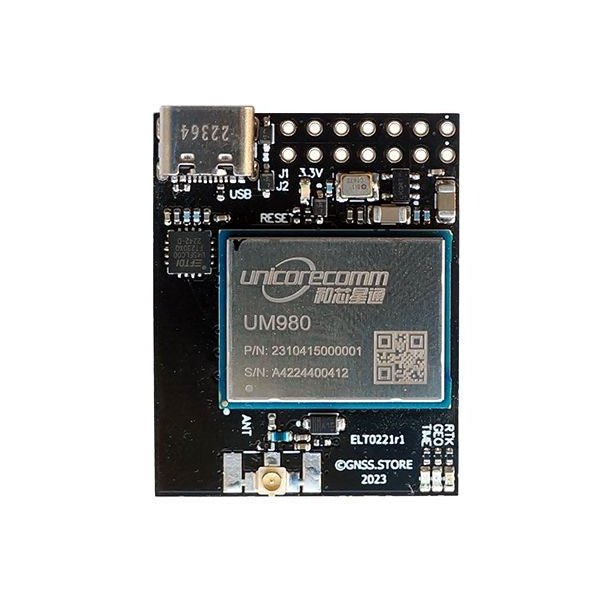

UM980 RTK InCase PIN GNSS receiver board with USB C
SKU: ELT0221-SRegular price
€169,99
Sale price
€169,99
Regular price


NEO-F9P-15B Multi-band L1,L5 RTK GNSS USB Dongle with SMA antenna connector
SKU: ELT0185Regular price
€219,99
Sale price
€219,99
Regular price


ZED-F9P RTK GNSS Smart Antenna module with USB-C, RFI protection and SMA Helix antenna. Black plastic case.
SKU: ELT0156-BPRegular price
From €209,99
Sale price
From €209,99
Regular price
Our high-precision RTK GNSS modules deliver centimeter-level accuracy for surveying, mapping, autonomous vehicles, and IoT systems. Supporting multiple GNSS constellations, they ensure reliable and efficient positioning.
Key Features of RTK GNSS Modules
- Multi-constellation support: GPS, GLONASS, Galileo, BeiDou, QZSS
- Centimeter-level accuracy: Real-Time Kinematic (RTK) technology
- Fast convergence: Quick initialization for dynamic applications
- Compact design: Easy integration into UAVs, robotics, and IoT devices
- Interference mitigation: Reliable performance in challenging environments
Applications
- Surveying & Mapping: Precise geospatial data collection
- Autonomous Vehicles: Accurate navigation and control
- IoT Systems: Location tracking for logistics and asset management
- Robotics: Enhanced navigation for autonomous robots
Why Choose These RTK Modules?
Designed for professionals, these RTK GNSS modules combine multi-constellation support with advanced features, delivering reliable, high-precision positioning for a wide range of applications.
FAQ: High Precision RTK GNSS modules
What is RTK and how does it achieve centimeter-level accuracy?
What is RTK and how does it achieve centimeter-level accuracy?
RTK (Real-Time Kinematic) is a satellite positioning technique that uses correction data from a fixed base station or NTRIP network to eliminate atmospheric and orbital errors in GNSS signals. While a standard GPS receiver achieves 2–5 meter accuracy, an RTK GNSS module such as the ZED-F9P or UM982 resolves carrier phase ambiguities in real time, delivering horizontal accuracy of 1 cm + 1 ppm — suitable for surveying, precision agriculture, UAV navigation, and autonomous vehicles.
What is the difference between ZED-F9P and NEO-F9P?
What is the difference between ZED-F9P and NEO-F9P?
Both are u-blox F9 generation multi-band RTK receivers with centimeter-level accuracy. The ZED-F9P is the full-featured variant with support for all interfaces (USB, UART, I2C, SPI), base and rover operation, and raw data output — making it the preferred choice for professional and industrial applications. The NEO-F9P is a smaller, lower-power variant in a more compact package, optimised for integration into size-constrained designs such as wearables, compact drones, and embedded modules where form factor is critical.
What is the difference between ZED-F9P and UM982?
What is the difference between ZED-F9P and UM982?
The ZED-F9P (u-blox) and UM982 (Unicore) are both professional multi-band RTK GNSS modules with centimeter-level accuracy, but differ in key capabilities. The UM982 is a dual-antenna module based on the Nebulas IV SoC — it supports simultaneous RTK positioning and dual-antenna heading calculation from a single chip, which makes it ideal for applications requiring direction information (AGV robots, autonomous mowers, precision agriculture machinery). The ZED-F9P supports single-antenna RTK only and requires an external compass for heading. For pure positioning the two are comparable; for heading + positioning in one module, the UM982 is the better choice.
Do I need a base station to use an RTK GNSS module?
Do I need a base station to use an RTK GNSS module?
Yes — RTK requires a source of correction data. You have two options: set up your own base station using a second RTK module (e.g. a second ZED-F9P in base mode) transmitting RTCM corrections over radio or serial link; or subscribe to an NTRIP correction service, which streams corrections from a network of reference stations over the internet. For most users NTRIP is the simpler option. Without corrections, the module operates as a standard high-performance GNSS receiver with meter-level accuracy.
Which RTK GNSS module is best for drones and UAVs?
Which RTK GNSS module is best for drones and UAVs?
For UAV applications the ZED-F9P is the most widely used choice — it is supported natively by ArduPilot, PX4, and most professional autopilot systems, offers fast RTK convergence on moving platforms, and is available in compact EVAL board form factors with IPEX/U.FL connectors suited for drone integration. The ZED-F9H is a heading variant of the F9 platform optimised specifically for moving base applications such as UAVs requiring dual-antenna heading. For agriculture drones requiring both RTK and heading in a single module, the UM982 is also an excellent option.
What GNSS constellations do your modules support?
What GNSS constellations do your modules support?
All high-precision RTK modules in our collection support multi-constellation reception. The ZED-F9P, NEO-F9P, UM982, and UM980 support GPS (L1/L2/L5), GLONASS (L1/L2), Galileo (E1/E5a/E5b), BeiDou (B1/B2/B3), and QZSS. Multi-constellation tracking improves satellite availability in urban canyons, under tree cover, and other challenging environments — resulting in faster RTK fix times and more robust positioning compared to single-constellation receivers.
What is the difference between NEO-M8P and ZED-F9P?
What is the difference between NEO-M8P and ZED-F9P?
The NEO-M8P is a previous-generation single-band RTK receiver operating on L1 frequency only. It achieves centimeter-level accuracy under good sky conditions but is more susceptible to multipath errors and longer convergence times in challenging environments. The ZED-F9P is a multi-band (L1+L2 or L1+L5) receiver with significantly faster RTK initialisation, better performance in urban or obstructed environments, and support for more GNSS constellations. For new designs we recommend the ZED-F9P — the NEO-M8P remains available for existing projects or cost-sensitive applications.
What antenna do I need for an RTK GNSS module?
What antenna do I need for an RTK GNSS module?
For RTK performance you need a multi-band active GNSS antenna that covers the frequencies used by your module. For L1/L2 RTK (ZED-F9P, UM982) you need an antenna covering at minimum GPS L1+L2 and ideally all GNSS L1/L2 bands. For L1/L5 variants, an L1/L5 multi-band antenna is required. Antenna quality directly affects RTK fix time and positioning accuracy — a high-quality survey-grade antenna with good multipath rejection will significantly outperform a basic patch antenna. We stock SMA and IPEX/U.FL connected multi-band antennas including IP67-rated helical spiral antennas for outdoor and UAV use.